
Choosing an implant torque instrument is not just a matter of comparing prices. A Dental Implant Torque Wrench must deliver the specified force and fit the connections used in a clinician’s workflow. Small differences matter: a clear scale, a steady ratchet, and a handle that stays comfortable during repeated adjustments can make daily use easier.
This guide introduces ten options for buyers and highlights the details worth checking before purchase. Compare each wrench’s torque range, stated accuracy, measurement units, calibration information, and compatibility with implant systems and driver components. Check how the manufacturer instructs users to clean, sterilize, store, and maintain the instrument. Do not assume every model is suitable for every procedure or can be processed in the same way. The instructions for use should settle those questions.
Look closely at the practical details. Can the markings be read under operatory lighting? Does the adjustment mechanism feel secure? Is the tool easy to handle with gloved fingers? These points may seem minor. They are not always minor.
Product specifications and availability can change, and published claims do not replace clinical judgment or manufacturer guidance. A comparison also has limits: a feature list cannot tell every buyer how a wrench will feel in practice. Use this overview as a starting point, then confirm current documentation, service support, and system compatibility before making a decision.
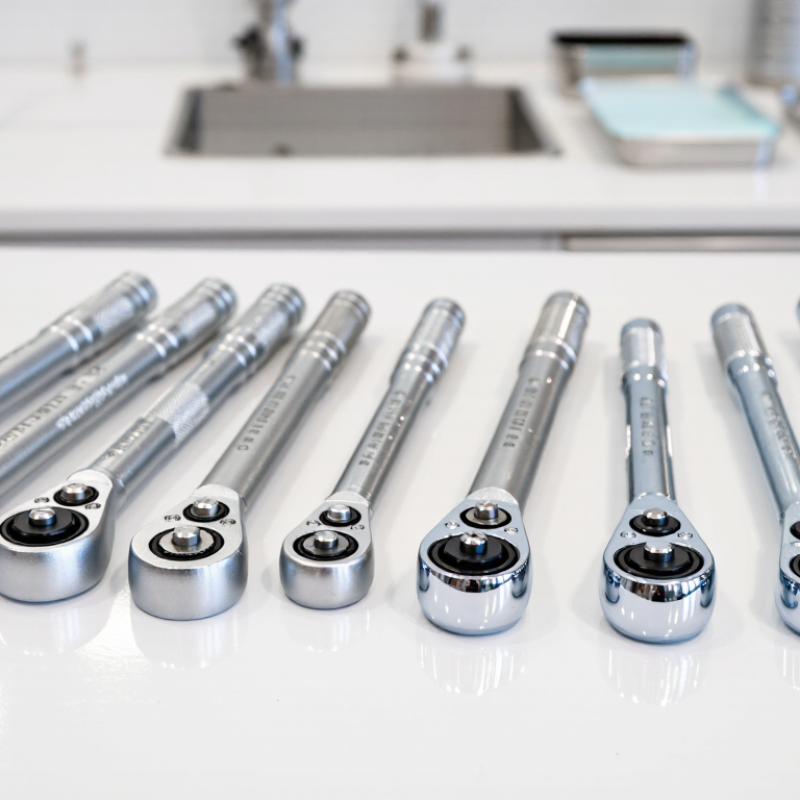
Implant torque is the rotational force applied as an implant enters prepared bone, measured in newton-centimeters (N·cm). Clinical values commonly span 10–50 N·cm, but this is a broad range, not a universal target. Bone density, site preparation, implant design, and the treatment plan all affect the reading. Soft bone may offer less resistance; dense cortical bone can raise torque quickly. Feel matters, but numbers help make decisions more consistent. They are not the whole story.
A torque wrench helps clinicians monitor force and avoid relying on hand pressure alone. Readings should be interpreted alongside the manufacturer’s instructions and the clinical situation, not chased as a score. Excessive resistance may call for reassessment rather than more force. One detail is easy to blur: implant insertion torque and the torque used to tighten a prosthetic screw are different measurements, with different recommendations. The wrench must suit the task and be maintained according to its instructions. Calibration can drift. That possibility deserves attention. A stable reading supports careful technique, but it cannot by itself predict healing or prove that an implant is ready for loading.
When comparing the top 10 dental implant torque wrenches, check that each model covers the torque values required by your implant system. A range is useful only when its markings are clear and the wrench can deliver the selected setting consistently. Look for readable graduations under operatory lighting, not just a wide range on paper. Small details matter. Ask how calibration is checked and how often the manufacturer recommends verification. A wrench that clicks or slips unpredictably should be removed from clinical use and assessed.
Connection type affects compatibility with drivers already used in the practice. Confirm the interface, locking mechanism, and driver fit before buying; a loose connection can interrupt controlled tightening. If staff use several implant platforms, compare whether one wrench supports the needed drivers without improvised adapters. That assumption can be wrong, so verify the fit directly.
Sterilization requirements deserve equal attention. Review the device instructions for cleaning, disassembly, autoclave conditions, and cycle limits. Repeated heat exposure may affect components over time, so keep maintenance and calibration records. Choose a design that can be cleaned without trapping debris in narrow joints. A convenient wrench is not automatically a durable one, and routine checks take time. Still, overlooking them may cost more in inconsistent performance than a careful selection process.
A practical top-ten comparison should focus on design, not an unsupported “best” ranking. The main options include preset, adjustable, beam-style, click-type, digital-display, ratcheting, compact, long-handle, interchangeable-head, and dual-scale wrenches. Preset models suit repeatable procedures with one torque target. Adjustable and dual-scale designs help clinics handling several implant systems. Beam-style tools show movement directly, while digital displays make readings easier to see. Ratcheting heads help in tight posterior spaces. Small details matter: a bulky handle can obstruct access near the cheek.
Clinical reliability depends on calibration and the correct target value. Jung and colleagues’ 2012 systematic review reported screw loosening in 8.8% of implant-supported single crowns over five years. That finding does not prove a wrench prevents loosening, but it shows why controlled tightening matters. Torque specifications vary by implant system and screw; clinicians should follow the relevant instructions rather than assume one setting fits all. ISO 6789-2:2017 describes calibration and uncertainty requirements for hand torque tools, useful context when assessing measurement claims.
For purchasing, compare scale visibility, grip, head access, sterilization compatibility, and documented calibration support. Ask whether readings remain dependable after repeated clinical cycles. Small clinics may value a simple preset tool; multi-system practices may prefer adjustable heads and clear scales. Still, a neat top-ten list can mislead: no design compensates for poor handling or missed maintenance.
| No. | Wrench Design | Torque Setting Approach | Typical Clinical Use | Practical Advantages | Buyer Considerations |
|---|---|---|---|---|---|
| 1 | Adjustable mechanical click-type | Torque is selected on an adjustable scale; the mechanism clicks or releases at the selected setting. Available ranges vary by system. | Routine tightening of compatible implant abutment and prosthetic screws. | One instrument can accommodate multiple prescribed torque values; the release provides tactile feedback. | Check scale readability, setting increments, compatible driver connections, and calibration guidance. |
| 2 | Preset fixed-torque wrench | Designed for one specified torque value; fixed settings commonly correspond to values prescribed by the relevant implant system. | Clinics with frequent procedures using the same specified torque. | Simple to operate and quick to verify before use. | A separate wrench may be needed for each torque value; confirm the exact output and intended screw connection. |
| 3 | Beam-type torque wrench | Torque is indicated by the deflection of a beam against a graduated scale. | Applications where the operator needs to observe the applied torque directly. | Direct visual indication and a relatively straightforward mechanical design. | Reading accuracy depends on viewing angle, scale visibility, and controlled hand movement. |
| 4 | Ratchet-style torque wrench | A ratcheting handle drives the compatible insert; torque control may be fixed or adjustable, depending on the design. | Intraoral screw tightening where repeated handle repositioning is useful. | Ratchet action can make access easier in areas with limited handle movement. | Confirm whether the ratchet is torque-limiting, the direction of operation, and the approved driver inserts. |
| 5 | Torque-limiting prosthetic driver | A driver incorporates a torque-control mechanism and is intended for a specified torque or range. | Final tightening of compatible prosthetic screws according to the applicable instructions for use. | Combines the driver and torque-control function in a compact instrument. | Compatibility is often connection-specific; verify the screw interface and the stated torque setting. |
| 6 | Interchangeable-head wrench | A torque handle accepts replaceable driver heads or inserts; the handle setting may be fixed or adjustable. | Practices using several compatible driver geometries. | One handle can serve multiple connections when approved inserts are available. | Check insert retention, connection compatibility, and whether each head is approved for the selected torque. |
| 7 | Digital torque wrench | An electronic sensor displays torque; features such as audible alerts or stored readings depend on the device. | Procedures where a numerical display or recorded readings are useful. | Clear digital readout can make the applied value easier to monitor. | Review battery requirements, display readability, calibration intervals, cleaning instructions, and system compatibility. |
| 8 | Contra-angle-compatible torque device | Connects to a compatible contra-angle or powered handpiece; the permitted torque and operating mode are device-specific. | Selected workflows that use a compatible powered driver for controlled screw tightening. | May reduce manual effort in workflows designed for powered instrumentation. | Use only within the manufacturer’s stated speed and torque limits; avoid assuming every handpiece connection is compatible. |
| 9 | Compact low-profile wrench | Uses a short or low-profile body with a fixed or adjustable torque mechanism. | Posterior access or other situations where handle clearance is limited. | Compact geometry can improve access in confined working areas. | Assess grip, scale visibility, driver length, and whether the compact form allows controlled application. |
| 10 | Multi-range, autoclavable mechanical wrench | Provides more than one selectable torque setting and is designed for reprocessing according to its instructions. | General implant restorative procedures across multiple prescribed torque values. | Can support varied clinical tasks with one reprocessable instrument. | Confirm the validated sterilization cycle, disassembly requirements, maintenance instructions, and calibration checks. |
Clinical note: This non-branded comparison describes common instrument designs, not ten specific products or a performance ranking. Torque ranges and settings vary by device and implant system. Always follow the applicable implant and instrument instructions for use, use the prescribed torque for the specific component, and observe the stated cleaning, sterilization, and calibration requirements.
A dental implant torque wrench is only clinically useful when its reading matches the implant system’s instructions for use. There is no single tightening value for every implant, abutment, or screw. Applying a familiar torque by habit can risk under-tightening or damage from over-tightening. Check the current instructions before treatment, and confirm the specified unit is N·cm. ISO 6789-1:2017 sets performance and calibration requirements for hand torque tools; its permissible error depends on tool type and range. It is a measurement standard, not a substitute for implant-specific guidance.
A practical buying check: look for a clear scale, secure setting, and documented calibration or verification process. Test the wrench at the working range, not only at its maximum setting. Keep it clean and dry, and store it without unnecessary load. A precise-looking click is not proof of accuracy. Small details matter.
Tips: Read the instructions at the chairside. Match the wrench range to the prescribed torque. Pause if the setting is unclear. Record periodic checks, and replace or service a tool that gives inconsistent readings. Even careful teams can miss a worn mechanism; routine verification is worth the extra minute.
Torque Unit Conversion Reference: Match tightening torque to the specific implant manufacturer’s instructions for use (IFU). These values show unit conversions only; they are not recommended tightening settings.
Conversion: 10 N·cm = 0.1 N·m. Always use the torque value and procedure specified in the applicable IFU; do not infer a clinical setting from this chart.
Choosing a Wrench: Compare Accuracy, Ergonomics, and Prosthetic Compatibility
A torque wrench should make the prescribed setting easy to select and repeat. Look for clear markings, a readable scale, and a mechanism that signals when the target is reached. Accuracy matters, but it should not be assumed from appearance alone. Check the manufacturer’s calibration guidance and service requirements. Small details count.
Grip the handle as you would during a procedure. A slim, balanced design can feel steadier when access is limited, while a bulky head may obstruct visibility near posterior implants. Test whether adjustments are easy with gloves on. Fiddly controls are frustrating.
Compatibility deserves equal attention. Confirm that the wrench accepts the driver or adapter used with the relevant implant and prosthetic components; connections are not always universal. Review cleaning and sterilization instructions, too, since not every instrument tolerates the same process. A wrench may look precise on a product sheet yet feel awkward in practice. That gap is worth considering, especially when comparing models side by side.